
Myanmar Snub-nosed Monkey
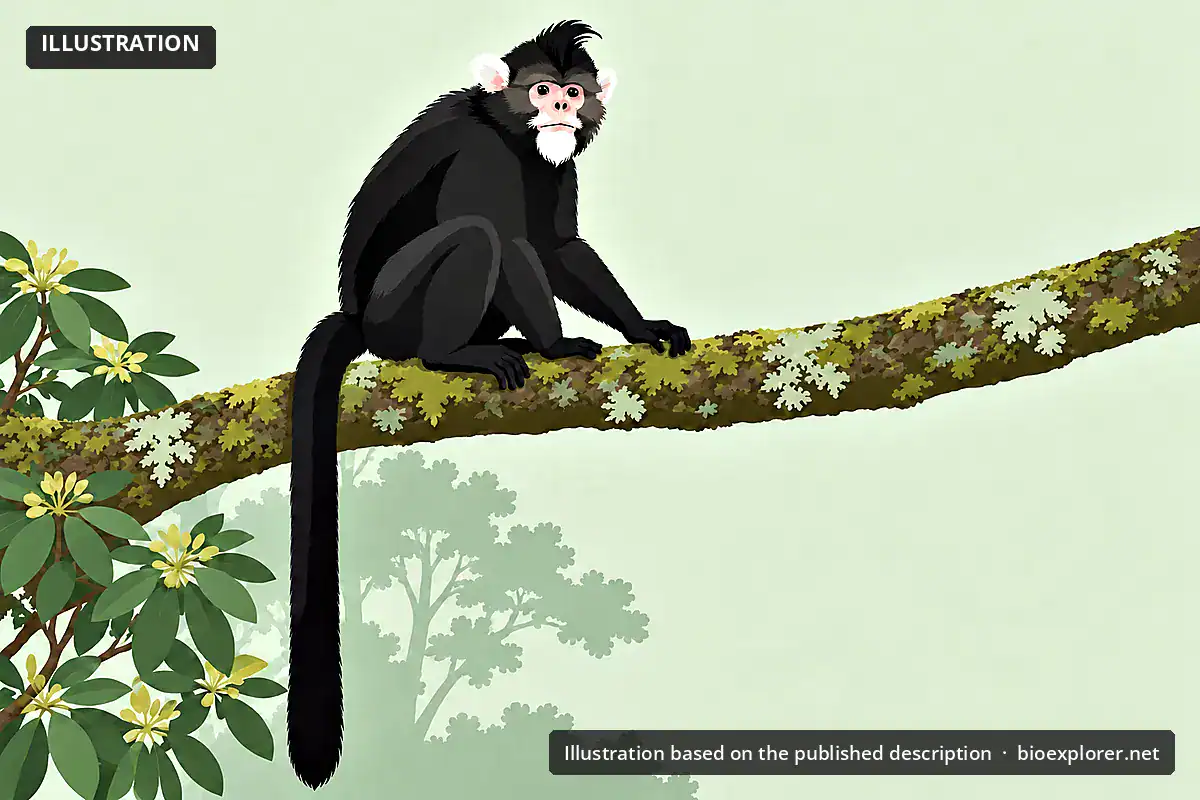
The Myanmar snub-nosed monkey is a nearly all-black Himalayan primate. Scientists first described it in 2011.[1] It lives in mountains on the Myanmar and China border. The IUCN lists it as Critically Endangered.[2] Local people say it sneezes when rain drips into its upturned nose.
It belongs to the Old World monkeys of Africa and Asia. Browse its relatives among all the types of monkeys.
This Critically Endangered monkey lives on the Myanmar and China border.

- Common NamesMyanmar snub-nosed monkey; Burmese snub-nosed monkey; Stryker's snub-nosed monkey
- Taxonomy Classification Year2011
- Monkey SizeHead and body 55.5 cm in the measured male, 52 to 54 cm in females
- Skin Color(s)Coat mostly black with white markings; exposed facial skin pale pink
- HabitatSteep mountain forest, about 1,720 to 3,370 meters
- DietHerbivorous
- Native CountriesMyanmar, China
- The one measured adult male weighed 17 kg.
- That male's tail ran about 1.4 times its body length.
- Bold white fur marks its ear tufts, beard and perineal area.
- In Myanmar, its presence was first confirmed by camera traps.
- Hunters say it moves down the mountains in winter.
Myanmar Snub-nosed Monkey Distribution
 )
 )
Myanmar Snub-nosed Monkey Guide:
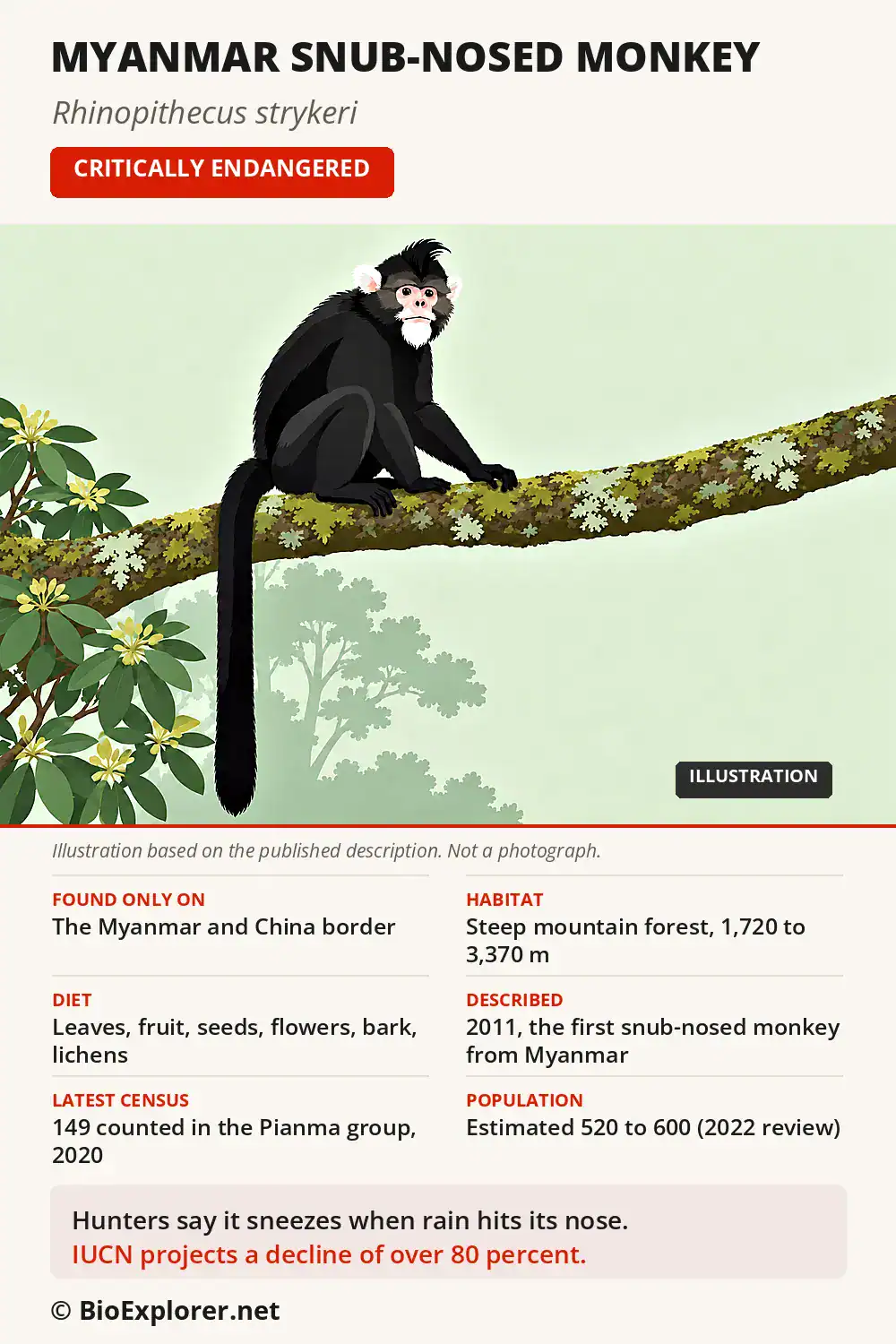
Classification and Naming
Thomas Geissmann and colleagues named the species in 2011. They worked from a skin and skulls obtained from local hunters. The type specimen came from the Maw River area of Kachin State. The team learned of the monkey while surveying gibbons.[3] The name strykeri honors Jon Stryker, founder of the Arcus Foundation. It was the first snub-nosed monkey ever reported from Myanmar.
The species has no subspecies.[4] Other English names are Burmese and Stryker's snub-nosed monkey. Some Chinese reports call it the Nujiang snub-nosed monkey.[5] Its name places it among the monkeys starting with M.
It is one of five Rhinopithecus species. China holds the golden snub-nosed monkey and the gray snub-nosed monkey. Vietnam holds the Tonkin snub-nosed monkey. Its closest relative is R. bieti, the black snub-nosed monkey.[6] That species is also called the Yunnan snub-nosed monkey. DNA studies place these two Himalayan species in one branch. Their split is recent by genetic standards. Confusingly, many papers call the Myanmar species the black snub-nosed monkey.[7]
Appearance and Size
This monkey is almost entirely black.[8] Bold white fur marks its ear tufts, beard and perineal area. The white ear tufts stick out from the sides of its head. That near-total black coat places it among the black monkeys.
A thin, tall crest of black hair curves forward over the crown. The face is mostly bare, with pale pink skin. Whitish hairs also form a mustache on the upper lip.
Very few have ever been measured.[9] The single measured adult male was 55.5 cm long. He weighed 17 kg. His long black tail ran about 1.4 times his body length. Two measured captive females were 52 to 54 cm long. They weighed 9 to 11.6 kg. Their tails measured 63 to 66 cm, about 1.2 times body length.
It differs from its Yunnan relative in several ways. It has no white on its belly or inner limbs. Its whiskers are white, not black. Its face skin is entirely pale pink. Its tail is also much longer.
Range and Habitat
In Myanmar, it lives around the Maw River in northeastern Kachin State. This area lies between the Salween and N'mai Hka rivers. The Mekong and Salween rivers separate it from other snub-nosed monkeys.
In 2011, it turned up in China's Gaoligongshan National Nature Reserve. That first Chinese record came from near Pianma, in Yunnan Province. Researchers later found a population at Luoma. Luoma lies on the eastern slopes, in the Salween River basin. The Gaoligong Mountains hold ten primate species.[10] The Skywalker hoolock gibbon also occurs in the wider range. Shortridge's capped langur also shares its forests.
The Red List gives an elevation range of 1,720 to 3,190 meters. The Pianma group used slopes from 2,143 to 3,372 meters. The slopes are very steep in most places. Its forests include subtropical evergreen broadleaf and mixed conifer forest. At Luoma, it lives in mixed broadleaf and hemlock forest. Hemlock and rhododendron forest is also used. Local hunters say the monkeys spend summer in high forest. They say the monkeys descend in winter, perhaps as snow hides food.
The group near Pianma crosses the China and Myanmar border. Researchers saw it cross into Myanmar three times in spring 2020. Its mapped home range covered 51.5 square kilometers. Another 5.5 square kilometers on the Myanmar side are presumed range.
Diet and Feeding
The monkey feeds on plants and lichens. A wild group at Luoma ate 14 plant species.[11] It also ate four kinds of lichen. That diet makes it one of the herbivorous monkeys.
Two captive monkeys were offered over 600 wild plant species. They ate parts of 170 species, plus 15 lichens. These included leaves, fruits, seeds, buds, flowers, twigs and bark. Every food the wild monkeys ate was also eaten by the captives.
Its food plants grow mainly in intact evergreen and hemlock forests. These forests lie between 2,200 and 3,000 meters. Lichens may matter most when snow covers the forest. Field reports say the monkeys depend on them in winter. That seasonal role has not been well measured.
Social Life and Behavior
Like its relatives, this monkey lives in a layered society. Small one-male units travel together in a larger band. Each unit holds one adult male, several females and young. All-male units follow the band.
On 18 November 2020, researchers counted the Pianma group. They counted 149 monkeys in 18 one-male units. Two all-male units traveled with them. The average one-male unit held about seven animals. Subgroups of 3 to 70 animals often split off and rejoined.
The species is active by day and lives high in trees. A 52-month study followed two wild populations. They spent most time in the canopy, 15 to 30 meters up. Sitting made up about 85% of their recorded postures. They moved by climbing, walking on all fours and leaping. Camera traps also caught them traveling on the ground.
Hunters told scientists a famous story about this monkey.[12] Rainwater drips into its upturned nose and makes it sneeze. So it may sit with its head between its legs. Hunters said they found it by listening for sneezes in the rain.
Discovery and First Photos
Fauna & Flora staff helped find the species in 2010.[13] They were surveying the forests of the Imawbum Mountains. Frank Momberg reported in 2012 that no scientist had seen one.
Local support staff met the monkeys directly only twice. Camera traps recorded a group of eleven animals. Three were mothers carrying infants. The Red List cites these details from his report. In China, researchers photographed a mother and infant at Luoma.
Population and Rarity
The 2011 description estimated 260 to 330 animals in Myanmar. That figure came from local reports and short surveys. No full census of the Myanmar groups has ever been done.
The Red List assessment dates from November 2015. It was published in 2020 and flagged as needing an update. It estimated 350 to 400 mature individuals. It called the earlier 260 to 330 figure probably an underestimate.
The 2020 census at Pianma counted 149 monkeys. Some were likely missed, so researchers estimated 155 to 160. That group had grown from about 100 in 2012 to 2014. An older estimate, from interviews, put the whole species below 950. A 2022 review confirmed at least six remaining groups.[14] It estimated 520 to 600 animals in total. That is an estimate of total individuals, not a census. The IUCN figure of 350 to 400 covers mature individuals only.
Genome studies compared all five snub-nosed species.[15] This species showed among the lowest genetic diversity. Its measured inbreeding ranked second highest of the five.
Main Threats
Hunting is one of the main threats. Hunters reported killing at least 13 of these monkeys in 2009. Some are hunted for their bones and heads. Others are caught by accident in iron traps. Those traps are set for deer or wild pigs.
The Red List says bones and heads are sold to Chinese workers. Traders in the border town of Kangfang also buy them. It is hunted for its fur as well. A bag made from a young monkey's skin was obtained in 2010. It came from a hunter.
Momberg also reported heavy logging in its Myanmar range by 2012. He said logging roads reached every area the species used. He said logging was removing mature conifers that carry winter lichens. He also reported sharply rising wild meat demand by 2011. The assessment predicted new dams and logging roads would raise hunting. It also predicted dam flooding would push shifting farms upslope.
Near Pianma, threats come mostly from the Myanmar side. Five monkeys, four of them infants, were captured as pets in 2019. In May 2020, researchers recorded poaching with guns and dogs. Mining and forest fires also threaten the border group.
Conservation Status
The Myanmar snub-nosed monkey is Critically Endangered under criterion A4cd. The IUCN estimated a reduction above 80% over 39 years. That window spans four past years and 35 projected ones. The assessment uses a generation length of 13 years. It is listed on CITES Appendix I.
China protects it at the highest level, Class I.[16] Its current national list took effect in February 2021.
In 2020, Myanmar declared Mount Imawbum National Park. Fauna & Flora supports community rangers and camera trap monitoring there. A 2017 habitat model predates that park. It mapped the species' habitat across both countries. Only 21.1% of that habitat lay in protected areas in China.
Common Questions
A 2022 review reported at least six groups. They total an estimated 520 to 600 animals. The IUCN lists 350 to 400 mature individuals. That 2015 figure counts mature individuals only and needs updating.
It lives in the Gaoligong Mountains along the Myanmar and China border. Its range covers Kachin State and western Yunnan Province.
Local hunters say rainwater drips into its upturned nose. They say it sneezes or tucks its head between its legs.
It eats leaves, fruits, seeds, buds, flowers and bark. It also eats lichens.
Scientists learned of it in 2010 and described it in 2011. It was the first snub-nosed monkey found in Myanmar.
Hunting and trapping are among the main threats. Logging, roads, dams, mining and fires threaten or degrade its habitat.
Cite this page
BioExplorer. (2026, October 23). Myanmar Snub-nosed Monkey. https://www.bioexplorer.net/animals/mammals/monkeys/myanmar-snub-nosed-monkey/
About the author