
Hoffmann’s Titi
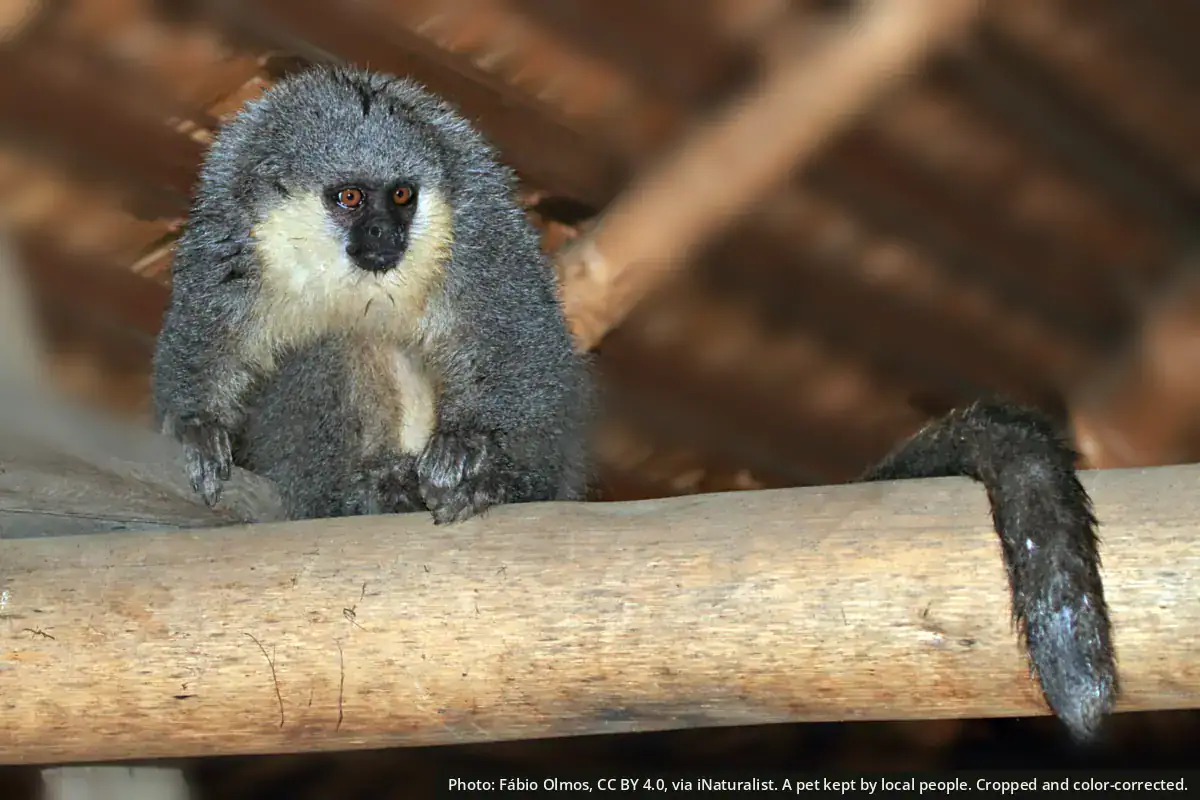
Hoffmann's titi is a gray titi with a pale yellowish chest. Oldfield Thomas named it in 1908.[1] It lives only in Brazil, south of the Amazon River. It is one of the New World monkeys.
Its home lies between the Tapajós and Abacaxis rivers. The IUCN lists it as Least Concern.[2] Yet almost nothing is known about its life in the wild.
This gray titi lives south of the Amazon in central Brazil.
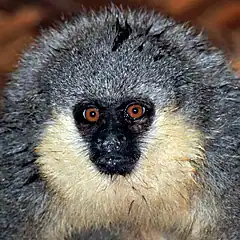
- Common NamesHoffmann's titi, Hoffmanns's titi, Hoffmann's titi monkey, zogue-zogue
- Taxonomy Classification Year1908
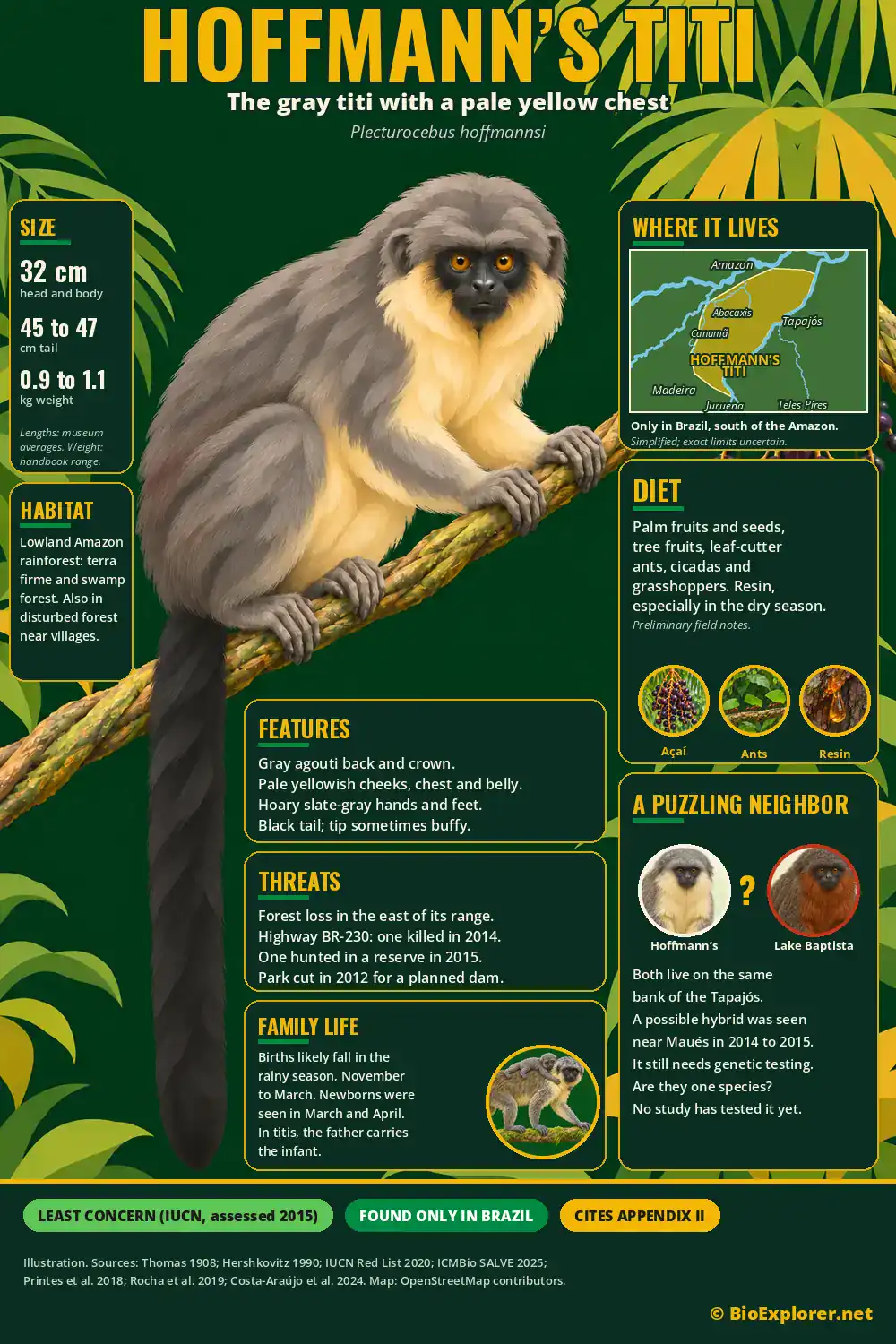
- Monkey SizeHead and body about 32 cm; tail about 45 to 47 cm; about 0.9 to 1.1 kg
- Skin Color(s)Gray agouti back and crown, pale yellowish cheeks and underparts, hoary gray hands and feet, black tail
- HabitatLowland Amazon rainforest, including terra firme and swamp forest
- DietPalm fruits, tree fruits, seeds, ants, resin and insects
- Native CountriesBrazil
- Its back and crown are gray agouti.
- Its cheeks, chest and belly are pale yellowish.
- Its hands and feet look hoary slate-gray.
- Its tail is black from base to tip.
- The IUCN lists it as Least Concern.
Hoffmann's Titi Distribution
 )
Hoffmann's Titi Guide:
Name and Classification
Oldfield Thomas described it in 1908 as Callicebus hoffmannsi. The type is an old male. W. Hoffmanns collected it in February 1906. He worked at Urucurituba, opposite Santarém on the Rio Tapajós. Thomas named the species after him. Its name places it among the monkeys starting with H.
The collector's name was Hoffmanns, with a final s. So the Mammal Diversity Database calls it Hoffmanns's titi.[3] Most sources still write Hoffmann's titi.
Its rank has shifted over the years. In 1990, Philip Hershkovitz made it a full species.[4] He treated the Lake Baptista titi as its subspecies. Later authors split the two again.
A 2016 DNA study moved it into the genus Plecturocebus.[5] It placed this titi in the moloch group. It found an early split from the rest of that group. That study dated the split to about 3.4 million years ago. A 2019 study gave about 2.4 million years.[6] That study also described the Alta Floresta titi.
Physical Description
Thomas described a grayish species with a light yellowish underside. The back is grayish brown with a faint reddish tinge. The crown is grizzled gray. Its arms and legs are grizzled gray too. That coat counts it among the gray monkeys.
The cheeks, chest, belly and inner limbs are pale yellowish or buffy. Thomas contrasted this with the strong red of related titis. That pale front makes it one of the yellow monkeys.
The hands and feet are blackish, grizzled with white. Together they look a hoary slate-gray. The tail is black from base to tip. Hershkovitz noted the tail tip is sometimes buffy. Unlike some titis, it lacks white ear tufts.
The 2019 study listed its colors part by part. Its crown, back, hands and feet are gray agouti. The sideburns, chest and inner limbs are yellowish.
One primate handbook describes a chestnut-brown back and orange-red front.[7] That clashes with the type description and later studies.
Size and Weight
Hershkovitz listed museum skins measured by collectors. Fourteen males averaged 32.2 cm in head and body. Sixteen females averaged 31.6 cm. Male tails averaged 45.3 cm. Female tails averaged 46.5 cm. He warned that collector measurements are not fully reliable.
Hershkovitz's table provides no specimen weights. The handbook gives 920 to 1,100 g. A Brazilian assessment gives about 920 g.[8] Neither states how many animals were weighed.
Similar Species Compared
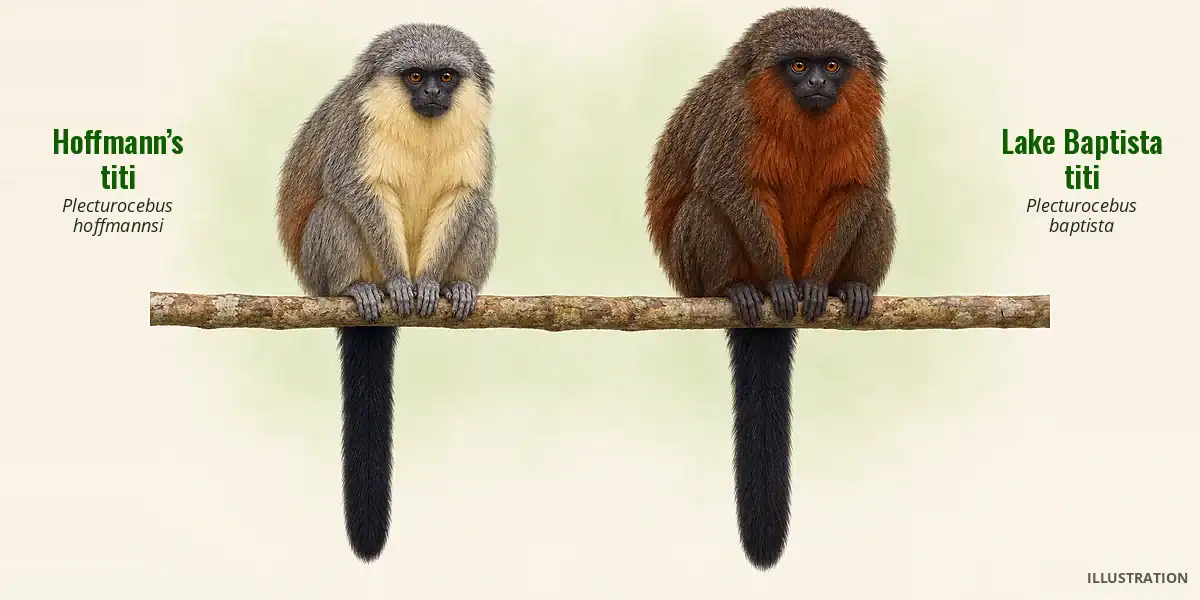
Taxonomic reviews treat the Lake Baptista titi as its closest relative. No genetic study has tested that link directly. It has a dark grayish back like Hoffmann's titi.[13] But its sideburns and front are dark reddish. Its hands and feet are blackish agouti.
The IUCN lists all three relatives as Least Concern.[12][14][16]
The red-bellied titi lives across the Rio Tapajós. Its front is light orange, not pale yellow.[15] Its tail tip is very pale, almost white.
The ashy black titi lives to the west and south. It is gray agouti nearly all over.[17] It lacks the contrasting front of the moloch group.
| Trait | Hoffmann's titi | Lake Baptista titi | Red-bellied titi | Ashy black titi |
|---|---|---|---|---|
| Scientific name | Plecturocebus hoffmannsi | Plecturocebus baptista | Plecturocebus moloch | Plecturocebus cinerascens |
| Range | South of the Amazon, Tapajós west to the Abacaxis and Canumã, Amazonas and Pará, Brazil | South of the Amazon, north of the Canumã, Urariá and Ramos channels, Amazonas, Brazil; also west bank of the Tapajós | East of the Tapajós and Juruena to the Tocantins and Araguaia, Pará and Mato Grosso, Brazil | Between the Aripuanã and the Tapajós and Juruena, Amazonas, Mato Grosso and Rondônia, Brazil |
| Habitat | Terra firme and swamp forest; also disturbed forest near villages | Primary and secondary forest | Lowland rainforest to about 300 m; small fragments | Terra firme, white-sand campinarana and riverside forest |
| Coat and key marks | Gray agouti above, pale yellowish cheeks and front, hoary gray hands, black tail | Dark grayish agouti above, dark reddish sideburns and front, blackish hands, blackish tail | Buffy gray to pale brown agouti, light orange front, tail tip almost white | Gray agouti, tawny mid-back, grayish or yellowish throat, blackish or grayish tail |
| Head and body | 32.2 cm (males), 31.6 cm (females), museum means | 33.7 cm (males), 35.1 cm (females), museum means | 33.3 cm (males), 33.1 cm (females), museum means | 33 to 40 cm (males), 32 to 38 cm (females) |
| Tail | 45.3 cm (males), 46.5 cm (females) | 45.8 cm (males), 44.6 cm (females) | 46.6 cm (males), 44.8 cm (females) | 39 to 48 cm |
| Weight | 920 to 1,100 g | 930 to 1,400 g | 850 to 1,200 g (males), 700 to 1,020 g (females) | 740 to 950 g |
| Diet | Palm and tree fruits, seeds, ants, resin, insects (preliminary) | Palm and tree fruits, seeds, ants, resin, small invertebrates (preliminary) | Not known | Not known |
| Group size | Not known | Not known | Not known | 2 to 7 |
| IUCN status | Least Concern (assessed 2015) | Least Concern (assessed 2015) | Least Concern (assessed 2020) | Least Concern (assessed 2021) |
Range and Distribution
Hoffmann's titi is endemic to Brazil. It lives in the states of Amazonas and Pará. Its range sits south of the Amazon River. The Rio Tapajós and Juruena bound it to the east. The Abacaxis and the Canumã and Sucunduri bound it to the west. It is one of the Brazilian monkeys.
The Tapajós splits it from the red-bellied titi. Hershkovitz found the two forms clearly distinct across that river. To the west, it may meet the ashy black titi. That contact zone lies around the upper Rio Abacaxis.
Its northern neighbor is the Lake Baptista titi. Channels called paranás were long seen as their border. Field records now complicate that picture. From 2008 to 2018, surveys logged 20 titi records near the Tapajós.[9] Twelve were Hoffmann's titis and eight were Lake Baptista titis. Both lived on the same west bank.
In 2014 and 2015, researchers worked near Maués, Amazonas.[10] They found Lake Baptista titis south of their supposed border. A Hoffmann's titi was seen about 2.5 km away. One animal showed mixed colors of both species. The authors called it a possible hybrid. It still needs genetic testing.
A 2024 survey also found Lake Baptista titis inside this titi's range.[11] Its authors suggest the two may be one species varying by place. No genetic study has tested whether they are separate species.
Habitat Needs
This titi lives in lowland Amazon rainforest. The handbook lists swamp forest and terra firme forest. That makes it one of the types of rainforest monkeys.
It seems to tolerate disturbed forest. In the Tapajós-Arapiuns Extractive Reserve, it is seen more often near villages. Primary forest records there are fewer. That note comes from unpublished data cited by the IUCN.
Near Maués, the researchers worked in secondary forest. One site bordered guaraná and rosewood plantations. A Hoffmann's titi was seen there about 2 m above ground.
Diet and Feeding
No full diet study exists for this titi. The Brazilian assessment gives preliminary field notes. It eats palm fruits and seeds, including açaí and buriti. It also eats fruit from many trees. It forages on the ground for leaf-cutter ants. It eats resin, especially in the dry season. Cicadas and grasshoppers are taken too.
That mixed menu puts it among the omnivorous monkeys. Its diet looks very similar to the Lake Baptista titi's.
Behavior and Family Life
Its group size has never been reported. Titis in general live as monogamous pairs with their young. The father carries the single infant.
The Brazilian assessment says births probably fall in the rainy season. That season runs from November to March. Females with newborns were seen in March and April. That was in Amazônia National Park.
Titis use loud calls to defend territories. Near the Tapajós, researchers played recorded titi calls. Hoffmann's and Lake Baptista titis answered calls of red-bellied titis. They did not answer recordings of their own species.
Population and Status
The IUCN lists it as Least Concern. It was last assessed on 26 January 2015. The IUCN calls it common and tolerant of change. Its population trend is unknown. The assessment is flagged as needing an update.
Unpublished surveys give densities along the middle and lower Tapajós. They found 1.68 to 5.04 titis per km². In Amazônia National Park, it ranked fifth among monitored mammals. That was by abundance in 2017 and 2018.
Brazil's national list also rates it Least Concern. It is listed on CITES Appendix II.
Threats and Protection
The IUCN names no major threats. Yet forest loss affects the eastern part of its range. The Transamazônica highway, BR-230, cuts through its range. One was killed on that road in 2014. One was hunted in the extractive reserve in 2015. Some records lie near gold-mining areas.
The IUCN assessment warned that a planned dam would cause habitat loss. That was the São Luiz do Tapajós dam. In June 2012, Brazil cut parts of Amazônia National Park.[18] That made room for the dam's planned reservoir.
The species lives in several large reserves. They include Amazônia National Park and Amana National Forest. The Tapajós-Arapiuns Extractive Reserve holds it too. It also lives in the Andirá-Marau Indigenous Territory. Explore more types of monkeys.
Common Questions
Hoffmann's titi has a gray back and crown. Its cheeks and chest are pale yellowish. Its tail is black.
Hoffmann's titi lives only in Brazil, south of the Amazon River. It ranges from the Rio Tapajós west to the Rio Abacaxis.
Hoffmann's titi measures about 32 cm in head and body. Its tail is about 45 cm. It weighs roughly 0.9 to 1.1 kg.
Hoffmann's titi eats palm fruits, tree fruits and seeds. It also eats ants, resin and insects.
Hoffmann's titi has a pale yellowish chest and gray hands. The Lake Baptista titi has a dark reddish chest and blackish hands.
No, the IUCN lists Hoffmann's titi as Least Concern. Roads, forest loss and mining are local concerns.
Cite this page
BioExplorer. (2026, November 17). Hoffmann’s Titi. https://www.bioexplorer.net/animals/mammals/monkeys/hoffmanns-titi/
About the author

Wildlife Writer and Photographer, BioExplorer.net
Arjun is a science writer and wildlife photographer at BioExplorer.net. He turns new research on animals into clear, accurate reads for curious readers. His work covers animal behavior, ecology, and newly described species. He holds a Cornell Lab of Ornithology certificate in bird biology. He is pursuing an HBSc at the University of Toronto Mississauga.