
Foa’s Red Colobus
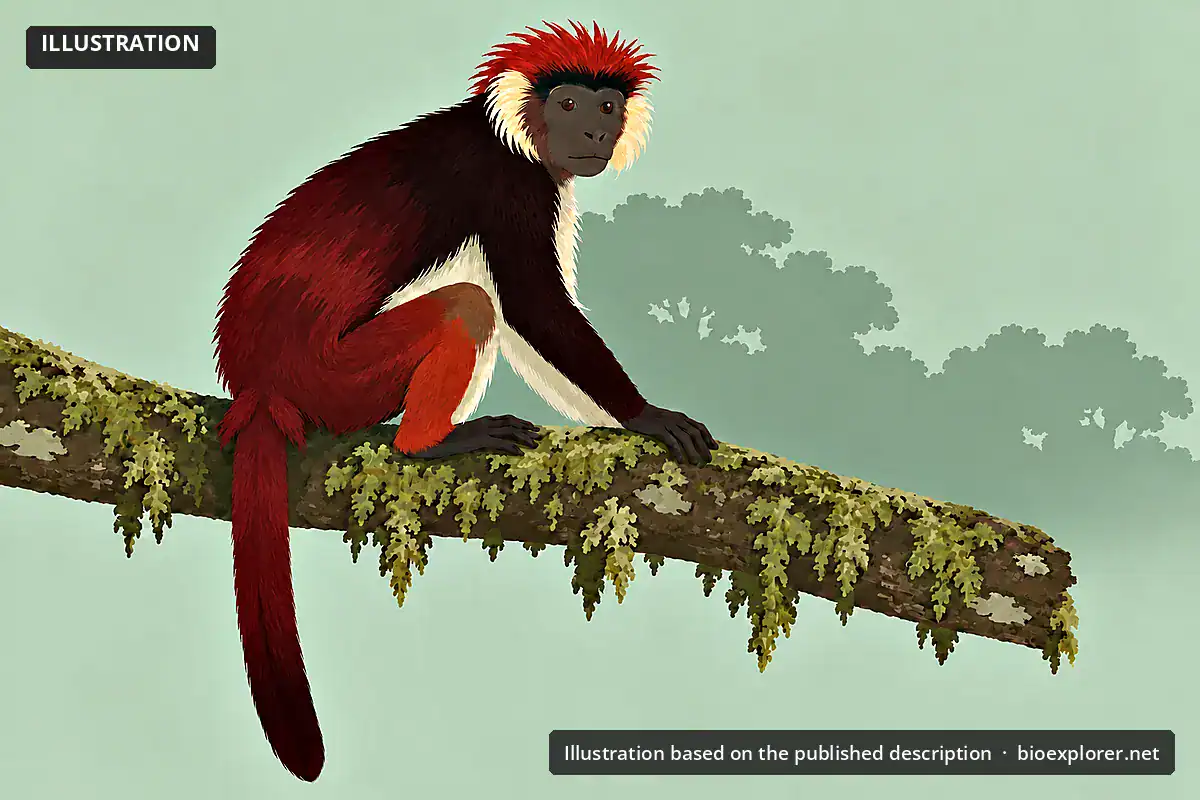
The Foa's red colobus is a rare mountain monkey of central Africa. Its scientific name is Piliocolobus foai.[1] It lives only in the Democratic Republic of the Congo. Its front half looks almost black, and its rear is red. A fiery red crest crowns its head. It is one of the Old World monkeys. The IUCN lists it as Endangered.[2] Only one population, at Kabobo, is confirmed.
This Endangered red colobus lives in mountain forests near Lake Tanganyika.
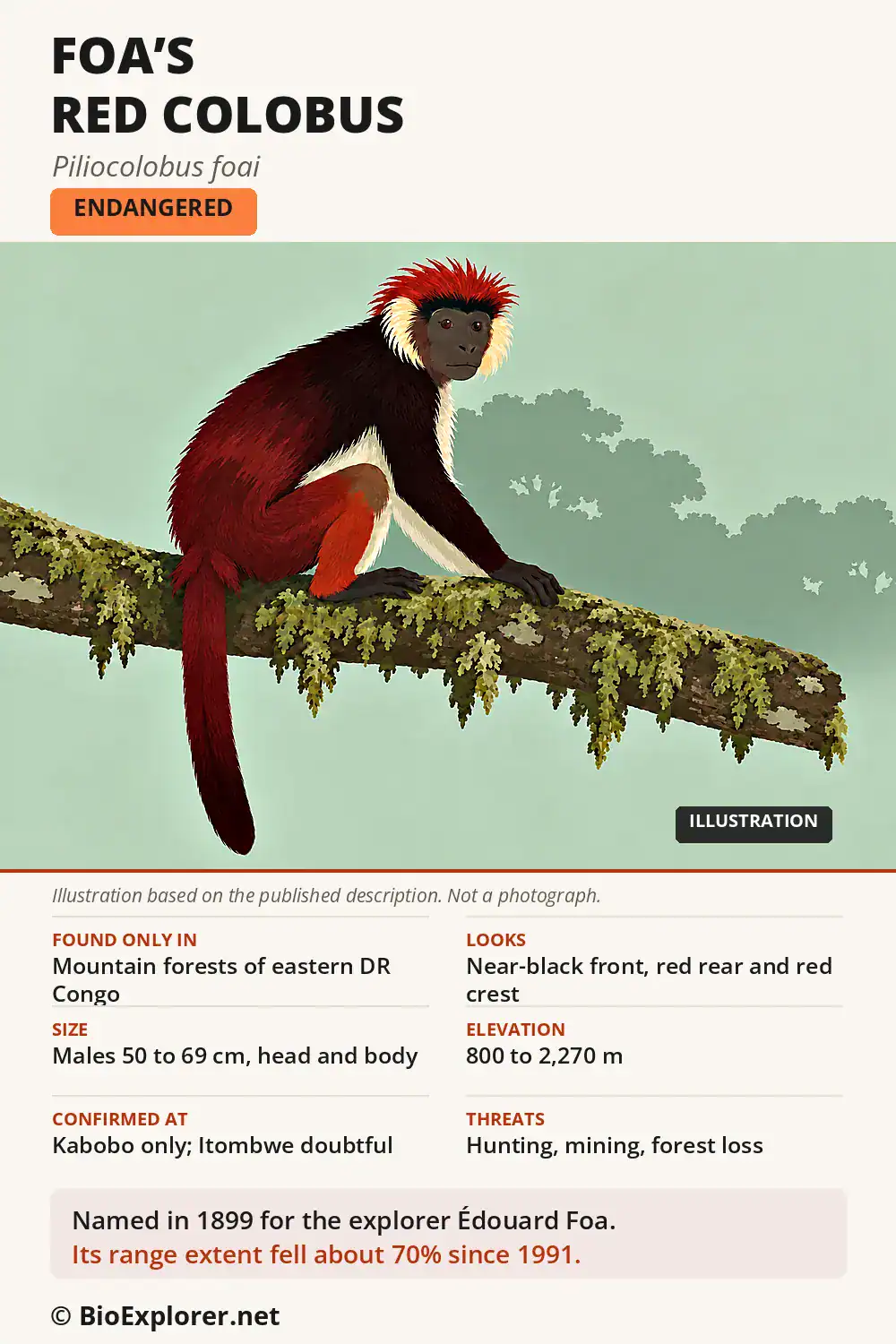
- Common NamesFoa's red colobus, Colobe de Foa (French)
- Taxonomy Classification Year1899
- Monkey SizeMales: head and body 50 to 69 cm, tail 62 to 67 cm (wider group)
- Skin Color(s)Near-black front, red rear and limbs, pale underparts
- HabitatMontane and submontane forest
- DietLeaves, fruit, flowers and buds, from a genus-wide account
- Native CountriesDemocratic Republic of the Congo
- Kabobo holds its only confirmed population; Itombwe's is doubtful.
- Its extent of occurrence fell about 70% between 1991 and 2020.
- A French zoologist named it in 1899, after Édouard Foa.
- Its type skin came from the Baluba people near Lake Tanganyika.
- The 2020 assessment reported no population estimate.
Foa's Red Colobus Distribution
 )
Foa's Red Colobus Guide:
Name and Classification
The French zoologist de Pousargues described this monkey in 1899.[3] He named it Colobus foai, after Édouard Foa. Foa bought the skin from the Baluba people. He was crossing Africa, from the Zambezi to the Congo. The skin came from the Ouroua mountains, west of Lake Tanganyika.
It was a flat skin from a nearly adult male. Its face, chin, hands and feet were missing. De Pousargues even marked it as a possible new species.
Today it sits in the genus Piliocolobus, with the other red colobus. They belong to the wider group of colobus monkeys.
Its limits are still debated. In 1991, Colyn separated a mountain form and a lowland form. The mountain form kept the name foai. The lowland form was lulindicus. Groves merged them again in 2007, citing continuous variation.
The Mammal Diversity Database follows Groves. It folds the Ulindi River red colobus into this species. The IUCN keeps the two apart, as a precaution. So does the 2021 red colobus action plan.[4] The plan calls the arrangement tentative, because of possible hybrids. This page follows the narrower IUCN view.
Physical Description
The original skin shows a striking two-part coat. The crown, neck and front body are very dark maroon brown. De Pousargues said they look almost black. Each hair there is red at the root, then mostly black.
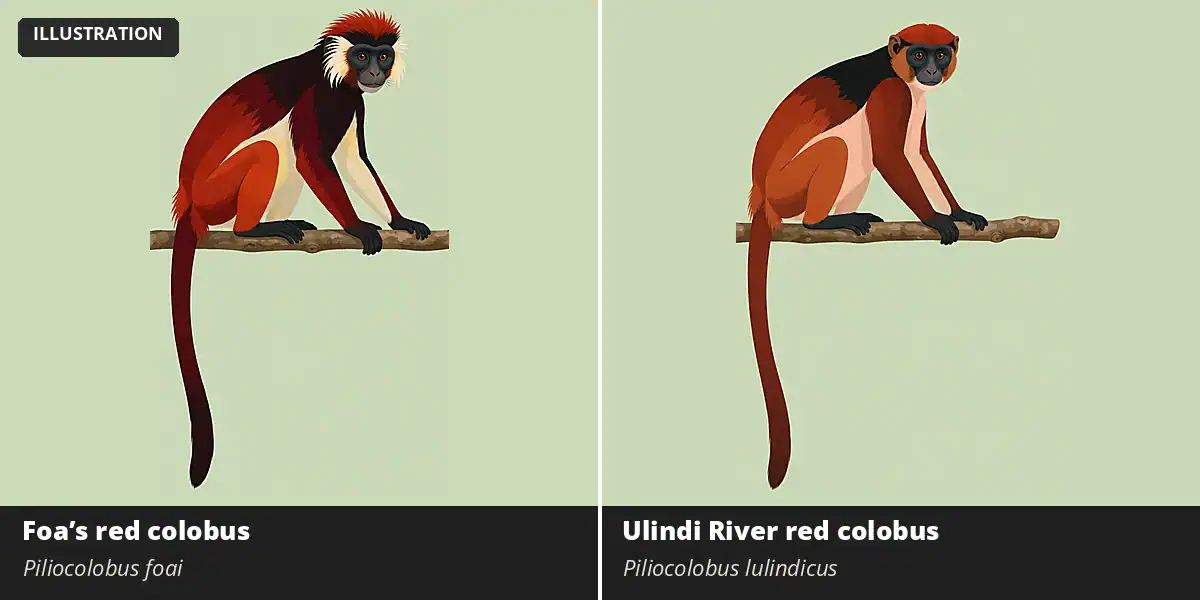
Toward the rear, the black fades away. The lower flanks, rump and tail base are reddish maroon. The outer hind limbs are a bright rust red. The tail darkens toward the tip.
The underside is grayish white, with a light yellow wash. A band of stiff black hairs stands up along the brow. Just behind it rises a crest of long, fiery red hairs. It fans out like a crown. Long yellowish white hairs frame each ear.
The fur is long. Back hairs reached 7 to 8 cm (2.8 to 3.1 in).
The Handbook of the Mammals of the World covers the wider group.[5] It notes a fairly short tail. The color above ranges from red to black, or a mix. The limbs are red, and the hands and feet are usually dark. A tuft grows on each side of the tail base. Its teeth are small for a red colobus.
That dark front places it among the black monkeys. Its red rear and limbs also fit the red monkeys.
Size and Weight
No flesh measurements exist for the mountain form alone. The type skin measured 50 cm (19.7 in), brow to tail root. Its tail measured 62 cm (24.4 in). These are dried skin figures, not live sizes.
The Handbook gives ranges for the wider group, Ulindi form included. Male head and body: 50 to 69 cm (19.7 to 27.2 in). Their tails are 62 to 67 cm (24.4 to 26.4 in). Males weigh 9 to 13 kg (19.8 to 28.7 lb). Females weigh 7 to 9 kg (15.4 to 19.8 lb). No female body lengths are given.
Similar Species Compared
The Ulindi River red colobus is its closest neighbor.[6] It lives in lowland forest to the west. The two meet where lowland forest gives way to mountains. That happens at about 1,200 to 1,500 m (3,900 to 4,900 ft). There they intergrade, and the mixed animals are treated as hybrids. Matschie described the Ulindi form in 1914.[7] Its underside is pale, and its arms are brick brown. Across its range, red forms live in the south. Red and black forms live in the north.
Lang's red colobus was once treated as part of this species.[8] It lives around Kisangani, far to the northwest. Its brick red front half meets a gray rear sharply.[9] Two weighed males were 7.65 kg (16.9 lb) each.[10] Foa's red colobus is the reverse, dark in front and red behind.
The Semliki red colobus lives to the north.[11] The action plan says the two likely intergrade there. The Semliki form has a gray front and a blackish mantle.[12] Its arms are brick red, and its tail is black.
| Trait | Foa's red colobus | Ulindi River red colobus | Lang's red colobus | Semliki red colobus |
|---|---|---|---|---|
| Scientific name | Piliocolobus foai | Piliocolobus lulindicus (IUCN); within P. foai in MDD | Piliocolobus langi | Piliocolobus semlikiensis |
| Range | Albertine Rift, eastern DR Congo: Kabobo; survival in Itombwe doubtful | Eastern DR Congo lowlands, from the Lualaba River east to about 28.5 E | Northeastern DR Congo, around Kisangani | Eastern DR Congo, possibly western Uganda |
| Habitat | Montane and submontane forest, 800 to 2,270 m | Lowland moist and riverside forest, 450 to 1,800 m | Primary lowland rainforest | Terra firma, swamp and riverine forest, 550 to 2,400 m |
| Coat and key marks | Near-black front, red rear and limbs, black brow band, red crest | Rust red crown, black nape, pale underside, brick brown arms; varies by region | Brick red front half, gray rear half, black tail | Gray front, blackish mantle, brick red arms, black tail |
| Head and body | 50 to 69 cm in males, wider group with Ulindi form | Not known separately | About 50 cm in males, 48.5 cm in females | Not known |
| Tail | 62 to 67 cm in males, wider group with Ulindi form | Not known separately | About 66.5 cm in males | Not known |
| Weight | 9 to 13 kg in males, 7 to 9 kg in females, wider group | Not known separately | Two males 7.65 kg each; two females 4.4 and 6.65 kg | Not known |
| Diet | Not studied in the wild | Assumed mainly leaves | Not studied in the wild | Assumed mainly leaves |
| Group size | Not known | Lives in groups; size not known | Not known | Not known |
| IUCN status | Endangered (2020 assessment) | Endangered (2020 assessment) | Endangered (2018 assessment) | Vulnerable (2020 assessment) |
Range and Distribution
It is found only in the Democratic Republic of the Congo. That makes it one of the Democratic Republic of the Congo monkeys.
It once ranged along the Albertine Rift highlands. Its range ran from Kahuzi-Biega National Park south through the Itombwe Massif. It reached the Kabobo Massif above Lake Tanganyika. Colyn suggested it reached the Lukuga River, but without specimens.
The 2020 assessment reported two widely separated locations. The first is the Kabobo Massif, on the Lake Tanganyika escarpment. There it occupies about 1,200 square km (460 sq mi) of forest. It is the only confirmed population. The second is the Itombwe Nature Reserve, farther north. Its survival there is doubtful.
Colyn's 1991 range spanned about 23,000 square km in extent of occurrence. That equals about 8,900 sq mi. By 2020, it was about 6,700 square km (2,600 sq mi). That is a decline of about 70%. If Itombwe's monkeys are lost, only Kabobo will remain.
It has not been recorded in Kahuzi-Biega for three decades. Surveys in 2015 confirmed its loss there.
Habitat Needs
It lives in primary montane and submontane forest. It lives at 800 to 2,270 m (2,600 to 7,450 ft). In Itombwe, it keeps to evergreen closed forest. At Kabobo, it also uses gallery forest on the escarpment. It is not known to go far into western forest islands.
Its mountain home is montane rainforest. That makes it one of the types of rainforest monkeys.
Diet and Behavior
No field study has described its diet. A genus-wide account lists young and mature leaves, fruit, flowers and buds. Seeds may be eaten too. Like its relatives, it counts among the herbivorous monkeys.
It is active by day and lives in the trees. Its group size has never been recorded in the wild. Most red colobus live in large groups with several males. Females usually outnumber males in those groups.
Females show a large pink swelling around ovulation. Nothing else is known about how it breeds.
Faced with a hunter, red colobus tend to watch, not flee. That makes them easy targets.
Population and Status
The 2020 assessment reported no population estimate. Kabobo is its last known stronghold. Surveys there recorded it several times in 2008.
Itombwe tells a grimmer story. A 1996 survey found monkeys scarce across the massif.[13] The overall primate encounter rate was 0.1 groups per km. The monkeys were mostly silent and often fled. The authors read this as a sign of heavy hunting. Patrols from 2003 to 2019 reported only one sighting. That report comes from Deo Kujirakwinja, as a personal communication. Hunters claimed it was still present in 2015. The action plan calls its survival there doubtful.
The IUCN listed it as Endangered in 2020. It rests on hunting and a 70% drop in extent of occurrence. Earlier assessments called it Data Deficient, in 1996 and 2000. From 1986 to 1994, it was listed as Insufficiently Known.
Major Threats
Hunting for bushmeat is a major threat. Red colobus are large, so each cartridge yields more meat. Hunters take them before smaller monkeys.
Habitat loss is the other big threat. Forest is cleared for farms, pasture and small-scale logging. Eastern Congo has the country's highest human densities.
Mining reaches deep into Itombwe. Artisanal miners work even its most remote areas. The 2020 assessment reported gold concessions held by Banro since 2011. They covered 2,616 square km (1,010 sq mi) around Itombwe.
At Kabobo, fires set for hunting and clearing harm the mountain forest. Hunting and mining also affect the Luama Hunting Reserve. Andrew Plumptre and Deo Kujirakwinja reported this as a personal communication.
Armed conflict has shaped both sites. Militias have been based in Itombwe and in the Kabobo Massif. Rebels at Kabobo kept out farmers, herders and miners. That lasted from the late 1970s until 1997. As security returned, people began to move in.
Conservation Efforts
A 2006 DRC order lists all red colobus as fully protected.
Its best hope is the Kabobo Massif reserve complex. The Kabobo Natural Reserve was approved on 21 December 2016.[14] It covers 1,477 square km (570 sq mi). The Ngandja Reserve was created that June. It covers 3,170 square km (1,224 sq mi). The older Luama Katanga Reserve dates from 1954. Together, the three cover 6,951 square km (2,684 sq mi).
The Kabobo reserve is now a Key Biodiversity Area.[15] Foa's red colobus is one of the species that qualify it.
The action plan sets out clear steps. It calls for surveys in Itombwe and across the Kabobo landscape. Teams would gather photos and fecal samples for genetic study. It also proposes a red colobus monitoring program at Kabobo.
Explore more monkeys starting with F. Or browse all types of monkeys.
Common Questions
It lives only in mountain forests of the eastern DR Congo. Its only confirmed population is in the Kabobo Massif.
Its front half is a very dark maroon that looks almost black. Its rear and legs are red. A red crest crowns its head.
Yes. The IUCN listed it as Endangered in 2020. Its extent of occurrence fell about 70% since 1991.
Wider-group males measure 50 to 69 cm, head and body. They weigh 9 to 13 kg.
It is named after Édouard Foa, a French explorer. He bought the first known skin near Lake Tanganyika.
No one knows. The 2020 assessment reported no population estimate. Only Kabobo has a confirmed population.
Cite this page
BioExplorer. (2026, October 28). Foa’s Red Colobus. https://www.bioexplorer.net/animals/mammals/monkeys/foas-red-colobus/
About the author