
Branches of Ecology
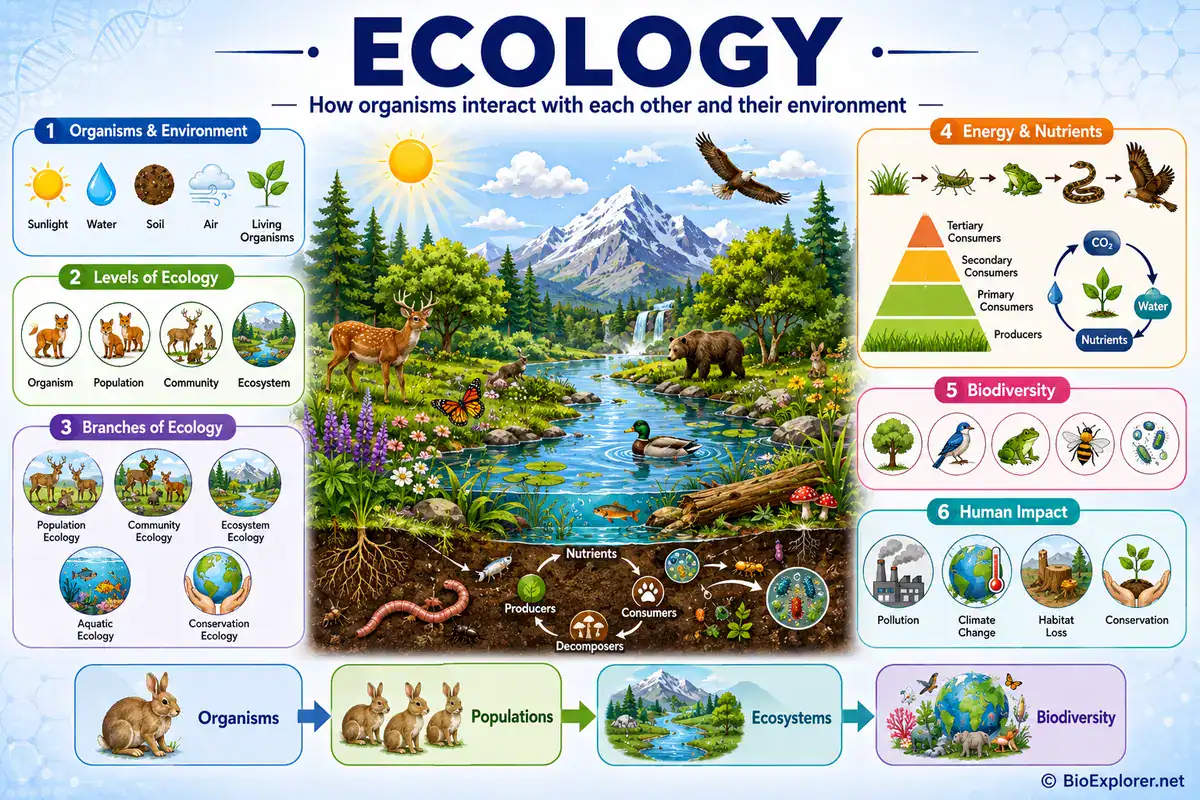
Ecology is the branch of biology that studies how living organisms interact with one another and with their physical environment. It examines relationships among organisms, populations, communities, ecosystems, and the nonliving factors that shape life, such as climate, water, soil, nutrients, sunlight, temperature, and oxygen.
Use the Ecology Glossary to learn terms such as ecosystem, habitat, niche, population, community, biodiversity, food chain, ecological pyramid, predator, prey, mutualism, and conservation.
Ecology Guide:
- What Ecology Studies
- Why Ecology Matters
- Main Levels of Ecology
- Autoecology and Synecology
- Major Branches of Ecology
- 1. Terrestrial Ecology
- 2. Aquatic Ecology
- 3. Microbial Ecology
- 4. Systems Ecology
- 5. Taxonomic Ecology
- 6. Evolutionary Ecology
- 7. Population Ecology
- 8. Behavioral Ecology
- 9. Conservation Ecology
- 10. Applied Ecology
- Other Important Ecology Branches
- Community Ecology
- Ecosystem Ecology
- Landscape Ecology
- Restoration Ecology
- Human Ecology
- Global Ecology
- Ecology Articles on BioExplorer
- Ecology Concepts and Environmental Processes
- Habitats and Ecosystems
- Animal Adaptations and Ecology
- Biodiversity, Conservation, and Environmental Issues
- Ecology News and Discoveries
- Related Biology Fields
- FAQs
- Recommended Ecology Resources
- Ecology Learning Resources
- Ecosystems, Biomes, and Environmental Science
- Biodiversity, Conservation, and Species Data
The branches of ecology help scientists study life at different scales. Some branches focus on individual organisms and their adaptations. Others study populations, communities, ecosystems, microbes, aquatic habitats, land environments, conservation, and human impact on nature.
Ecology connects closely with evolution, botany, zoology, microbiology, genetics, biotechnology, marine biology, and environmental science. It helps explain how species survive, how ecosystems function, how energy and nutrients move through nature, and how human activity affects biodiversity.
What Ecology Studies
Ecology studies the relationships between living organisms and their environment. These relationships include how organisms find food, avoid predator, reproduce, compete for resources, cooperate with other species, and survive in changing habitats.
- Ecologists study both living and nonliving parts of nature. The living parts include plants, animals, fungi, bacteria, algae, protists, and other organisms. The nonliving parts include air, water, soil, rocks, sunlight, temperature, pH, minerals, and climate.
- Ecology also studies natural systems at different levels. A single bird, tree, bacterium, or fish can be studied as an organism. A group of the same species in one place forms a population. Different species living and interacting in the same area form a community. A community plus its physical environment forms an ecosystem.
This makes ecology one of the most connected branches of biology. It does not study organisms in isolation. It studies organisms in context.
Origin and History of Ecology
The word ecology comes from the Greek word oikos, meaning household or home, and logia, meaning study. In a literal sense, ecology means the study of the household of nature.
- The German biologist Ernst Haeckel introduced the term ecology in 1866. He used it to describe the study of organisms in relation to their surrounding environment. Since then, ecology has grown into a major biological science with many specialized branches.
History of Ecology
Early ecology focused heavily on plants, animals, natural history, and the distribution of species. Over time, the field expanded as scientists studied energy flow, population growth, food webs, nutrient cycles, microbial communities, climate effects, conservation, and ecosystem management.
Today, ecology helps scientists understand forests, oceans, deserts, wetlands, grasslands, cities, farms, coral reefs, soil systems, and even microbial communities inside animal bodies.
Why Ecology Matters
Ecology matters because living organisms depend on one another and on their environment. No organism exists alone. Plants need sunlight, water, minerals, pollinators, soil organisms, and suitable climate conditions.
- Animals depend on food, shelter, mates, oxygen, water, and habitat. Microorganisms recycle nutrients, support soil health, influence disease, and shape ecosystems in ways that are often invisible.
- Ecology helps explain major environmental issues such as habitat loss, climate change, invasive species, pollution, biodiversity loss, soil degradation, disease spread, and overuse of natural resources.
- Ecology also supports practical decision-making. Conservationists use ecology to protect species and habitats. Farmers use ecological knowledge to manage soils, pests, pollinators, and crops.
- Public health experts use ecology to understand disease transmission. Wildlife managers use ecology to study animal populations. Climate scientists use ecological data to understand how ecosystems respond to warming, drought, fire, and land-use change.
Without ecology, it would be difficult to protect biodiversity, manage natural resources, restore damaged habitats, or understand how human activity changes the living world.
Main Levels of Ecology
Ecology can be studied at several levels of biological organization. These levels help scientists decide whether they are studying one organism, one species, many species, or an entire ecosystem.
| Level of Ecology | What It Studies | Example |
|---|---|---|
| Organism | How one organism survives and responds to its environment | A cactus conserving water in a desert |
| Population | Members of the same species in one area | A population of deer in a forest |
| Community | Different species interacting in the same area | Birds, insects, trees, fungi, and mammals in a woodland |
| Ecosystem | Living organisms plus their nonliving environment | A pond, forest, coral reef, or grassland |
| Biome | Large regions with similar climate and life forms | Desert, tundra, rainforest, grassland |
| Biosphere | All ecosystems on Earth | The global system of life, air, land, and water |
These levels are connected. A change at one level can affect the others. For example, a drought may reduce plant growth in an ecosystem, which can affect herbivore populations, predator behavior, soil organisms, and nutrient cycling.
10 Levels of Biological Organization
Autoecology and Synecology
Ecology has often been divided into two broad subdivisions: autoecology and synecology.
- Autoecology studies individual species or populations in relation to their environment. It asks how a species survives, reproduces, adapts, and responds to environmental factors. For example, autoecology may study how a desert lizard regulates body temperature or how a plant species survives in salty soil.
- Synecology studies groups of species living together in communities and ecosystems. It looks at species interactions, community structure, food webs, ecological succession, and the relationships among living and nonliving parts of an ecosystem.
These two subdivisions are useful, but modern ecology is much broader. Today, ecologists also study microbial systems, landscapes, climate interactions, human impacts, conservation planning, restoration, disease ecology, and global ecological change.
Major Branches of Ecology
The branches of ecology focus on different environments, organisms, interactions, and applications. Some branches are based on habitat type, such as terrestrial ecology and aquatic ecology. Others are based on scale or method, such as population ecology, systems ecology, and applied ecology.
Here are 10 important branches of ecology.
1. Terrestrial Ecology
Terrestrial ecology studies organisms and ecosystems on land. It focuses on forests, grasslands, deserts, tundra, mountains, savannas, agricultural landscapes, and other land-based habitats.
This branch examines how land organisms interact with each other and with environmental factors such as soil, rainfall, temperature, sunlight, fire, wind, nutrients, and elevation. It also studies how land ecosystems respond to drought, climate change, invasive species, pollution, habitat loss, and human land use.
Soil is especially important in terrestrial ecology. Soil moisture, pH, nutrients, texture, organic matter, and microbial life can strongly influence plant communities and animal habitats.
Examples of terrestrial ecology include studying desert bird adaptations, rainforest biodiversity, grassland food webs, forest succession, and tundra animal survival.
2. Aquatic Ecology
Aquatic ecology studies organisms and ecosystems in water. It includes freshwater ecosystems, marine ecosystems, and estuaries where rivers meet the sea.
Freshwater ecology includes lakes, ponds, rivers, streams, wetlands, and groundwater systems. Marine ecology includes oceans, coral reefs, rocky shores, seagrass beds, kelp forests, and deep-sea environments. Estuarine ecology studies brackish habitats shaped by both freshwater and saltwater.
Aquatic ecologists study water temperature, salinity, oxygen levels, nutrient concentration, light penetration, currents, pH, pollution, predation, competition, and food webs. These factors affect algae, fish, invertebrates, microbes, aquatic plants, marine mammals, and many other organisms.
Aquatic ecology is important for fisheries, coral reef conservation, water quality, wetland protection, and climate change research. Adaptations in ocean animals show how life survives under pressure, salinity, cold, darkness, currents, and limited food.
3. Microbial Ecology
Microbial ecology studies microorganisms and their relationships with each other, with larger organisms, and with the environment. It includes bacteria, archaea, fungi, protists, algae, and microscopic communities that live in soil, water, air, sediments, plants, animals, and human bodies.
Microbes play major roles in nutrient cycling, decomposition, soil fertility, disease, digestion, fermentation, symbiosis, and ecosystem productivity. They also help drive biogeochemical cycles such as the carbon cycle and nitrogen cycle.
Microbial ecology includes the study of biofilms, gut microbiomes, soil microbes, marine microbes, plant-associated microbes, and microbial communities in extreme environments. It also connects closely with microbiology, molecular biology, environmental science, and biotechnology.
Understanding the difference between prokaryotic and eukaryotic cells helps explain why bacteria and archaea differ from cells found in animals, plants, fungi, and protists.
4. Systems Ecology
Systems ecology studies ecosystems as complex systems made of interacting living and nonliving parts. It often uses models, data analysis, mathematics, computer simulations, and systems thinking to understand how ecosystems function.
This branch looks at energy flow, nutrient cycling, feedback loops, food webs, population changes, ecosystem stability, and responses to disturbance. It helps ecologists understand how one change, such as pollution, fire, drought, or species loss, can affect many other parts of an ecosystem.
Systems ecology is especially useful when studying large and complicated processes such as the carbon cycle, biogeochemical cycles, climate effects, and ecosystem productivity.
For example, a systems ecologist may study how carbon moves among plants, animals, soil, water, and the atmosphere. Another may model how a wetland responds to changes in rainfall, nutrient runoff, and plant cover.
5. Taxonomic Ecology
Taxonomic ecology uses species identification and classification to understand ecosystems. It connects ecology with taxonomy, the science of naming and classifying organisms.
This branch is important because ecologists must know which organisms are present before they can study interactions, biodiversity, food webs, species richness, invasive species, or conservation priorities. Accurate identification helps scientists compare ecosystems and track changes over time.
Taxonomic data can show whether a habitat contains rare species, dominant species, indicator species, invasive species, or species that play key ecological roles. It also helps scientists understand how communities differ across forests, wetlands, reefs, grasslands, and other habitats.
Taxonomic ecology is not always listed as one of the most common branches in modern textbooks, but taxonomy remains essential to ecological research. Without reliable identification, studies of biodiversity and community structure become weak.
6. Evolutionary Ecology
Evolutionary ecology studies how ecological interactions influence evolution and how evolutionary changes affect ecological relationships. It connects ecology with the studies of evolution.
This branch examines how natural selection, adaptation, competition, predation, parasitism, mutualism, sexual selection, and environmental pressures shape species over time. It also studies how traits affect survival and reproduction in real ecological settings.
For example, evolutionary ecology may study why some animals develop camouflage, why plants evolve chemical defenses, why predators and prey influence each other's traits, or how isolated populations change through the founder effect.
Evolutionary ecology is important because species do not evolve in a vacuum. They evolve while interacting with predators, prey, competitors, parasites, mates, climate, and habitat conditions.
7. Population Ecology
Population ecology studies groups of individuals from the same species living in a particular area. It focuses on population size, density, distribution, birth rate, death rate, age structure, migration, growth rate, and survival.
This branch asks questions such as:
- Why does a population increase or decrease?
- How many individuals can a habitat support?
- What limits population growth?
- How do predators, disease, food, climate, and competition affect population size?
- How do populations recover after disturbance?
Population ecology is important in wildlife management, conservation biology, fisheries, agriculture, pest control, disease ecology, and endangered species protection.
For example, a population ecologist may study whether a bird population is declining because of habitat loss, reduced nesting success, climate stress, or increased predation.
8. Behavioral Ecology
Behavioral ecology studies how animal behavior affects survival and reproduction in different environments. It connects behavior with ecology, evolution, and natural selection.
This branch examines feeding behavior, mating behavior, parental care, migration, territoriality, communication, social behavior, predator avoidance, cooperation, aggression, and foraging strategies.
Behavioral ecologists ask why organisms behave in certain ways and how those behaviors help or hurt reproductive success. For example, they may study why birds migrate, why primates groom one another, why insects live in colonies, why animals defend territories, or how predators influence prey behavior.
Behavioral ecology is closely related to ethology, animal behavior, zoology, and evolutionary biology. Ethological theory provides related background for understanding how animal behavior is studied in natural and evolutionary contexts.
9. Conservation Ecology
Conservation ecology studies how ecological knowledge can protect species, habitats, and ecosystems. It focuses on biodiversity, endangered species, habitat loss, restoration, invasive species, climate change, pollution, and ecosystem recovery.
This branch is closely related to conservation biology, but it emphasizes ecological principles such as population size, habitat quality, species interactions, genetic variation, food webs, and ecosystem processes.
Conservation ecology helps scientists and policy makers decide which habitats need protection, how wildlife corridors should be designed, how damaged ecosystems can be restored, and how species can recover from decline.
Conservation ecology often uses knowledge from genetics, biogeography, population biology, environmental ethics, law, and natural resource management.
10. Applied Ecology
Applied ecology uses ecological knowledge to solve real-world problems. It takes concepts from ecology and applies them to conservation, agriculture, forestry, fisheries, urban planning, public health, restoration, climate adaptation, pollution control, and natural resource management.
Applied ecologists may study how to restore a wetland, reduce crop pests, manage wildlife, control invasive species, improve water quality, reduce disease risk, plan protected areas, or make cities more ecologically resilient.
This branch is especially important because human activity affects ecosystems at local, regional, and global scales. Applied ecology helps turn ecological research into practical action.
Applied ecology may connect with biotechnology, environmental science, geography, economics, public policy, and engineering, but its core goal remains ecological: to understand living systems well enough to manage them responsibly.
Other Important Ecology Branches
The 10 branches above are useful for learning the subject, but ecology includes many additional specialties. Some are widely used in modern research and education.
Community Ecology
Community ecology studies interactions among different species living in the same area. These interactions include competition, predation, herbivory, mutualism, parasitism, commensalism, and disease.
Community ecology helps explain why some species are abundant, why others are rare, and how food webs and species interactions shape biodiversity.
Ecosystem Ecology
Ecosystem ecology studies the movement of energy and matter through ecosystems. It examines primary production, decomposition, nutrient cycling, food chain, food webs, and interactions between organisms and the physical environment.
Ecological pyramids are especially relevant here because they show relationships involving energy, biomass, and numbers of organisms in ecosystems.
Landscape Ecology
Landscape ecology studies ecological patterns across large areas. It examines habitat patches, corridors, fragmentation, land-use change, and how organisms move across landscapes.
This field is important for conservation planning, wildlife corridors, urban ecology, forest management, and habitat restoration.
Restoration Ecology
Restoration ecology studies how damaged ecosystems can be repaired. It may involve replanting native species, removing invasive species, restoring wetlands, rebuilding soils, reconnecting habitats, or improving water flow.
Restoration ecology is practical, but it depends on strong ecological theory.
Human Ecology
Human ecology studies relationships between humans and their environments. It examines how human societies use resources, change landscapes, affect ecosystems, and depend on ecological systems.
Urban ecology, environmental health, agriculture, conservation planning, and sustainability research often overlap with human ecology.
Global Ecology
Global ecology studies ecological patterns and processes at planetary scales. It looks at climate change, carbon cycling, biodiversity patterns, land-use change, ocean productivity, and the biosphere as a whole.
Ecology Articles on BioExplorer
BioExplorer includes several ecology articles covering ecosystems, adaptations, biodiversity, environmental issues, rainforests, food chains, energy flow, and conservation.
Ecology Concepts and Environmental Processes
- Explore Ecological Pyramid: 3 Major Types and Limitations: Learn how ecological pyramids represent energy, biomass, and numbers of organisms in ecosystems.
- What Is Biological Magnification?: Understand how pollutants can become more concentrated as they move through food chains.
- Explore Types of Greenhouse Gases As Agents Of Climate Change: Learn how greenhouse gases affect climate and ecosystems.
- Carbon Cycle Steps: Explore how carbon moves through living organisms, soil, water, rocks, and the atmosphere.
- Top 20 Biomass Energy Pros and Cons: Review the ecological benefits and limitations of biomass energy.
Habitats and Ecosystems
- Explore The Layers Of The Rainforest: Learn about the emergent layer, canopy, understory, and forest floor.
- Top Spectacular Rainforests of The World: Explore major rainforests and their ecological importance.
- Top 18 Amazon Rainforest Plants: Learn about plant diversity in the Amazon rainforest.
- What Animals Live In Rainforests?: Explore animal life in tropical rainforest habitats.
- Types of Monkeys Live In Rainforest: Learn about rainforest monkeys and their habitats.
Animal Adaptations and Ecology
- Explore 15 Remarkable Adaptations of Ocean Inhabitants: Learn how marine organisms survive in ocean habitats.
- Explore Desert Birds & Their Adaptations: See how birds survive in dry and harsh desert environments.
- Top 18 BEST Tundra Animal Adaptations: Explore survival strategies in cold ecosystems.
- Top 7 Tropical Rainforest Animal Adaptations: Learn how animals survive intense competition in rainforests.
Biodiversity, Conservation, and Environmental Issues
- Top 6 Major Threats To Biodiversity: Understand the main drivers of biodiversity loss.
- Top 15 Current Environmental Issues in the US: Explore major environmental concerns affecting ecosystems.
- Top 15 Wildlife Biology Degree Programs In The USA: Learn about educational paths related to wildlife biology and ecology.
Ecology News and Discoveries
- 15 Leading Ecology News of 2018: Review notable ecology-related developments from 2018.
- Top 10 Discoveries in Ecology 2019: Explore ecology discoveries and research highlights from 2019.
- Top 10 Ecology News of 2020: Read a roundup of ecology research and environmental developments from 2020.
- Top 15 Ecology News of 2021: Review major ecology research updates and environmental developments from 2021.
- Top 15 Ecology News of 2022: Explore notable ecology news, discoveries, and environmental research highlights from 2022.
Related Biology Fields
Ecology overlaps with many other branches of biology and environmental science.
- Evolutionary Biology: Explains how ecological pressures shape adaptation, natural selection, and species change over time.
- Zoology: Studies animals, including their behavior, habitats, diets, and ecological roles.
- Botany: Studies plants, which form the base of many food webs and shape habitats.
- Microbiology: Studies microorganisms that drive decomposition, nutrient cycling, symbiosis, and disease.
- Genetics: Helps explain variation, adaptation, population change, and conservation genetics.
- Marine Biology: Studies ocean life, marine ecosystems, coral reefs, fisheries, and aquatic food webs.
- Biotechnology: Applies biological knowledge to agriculture, conservation, environmental cleanup, and industry.
- Environmental Science: Combines ecology with chemistry, geology, climate science, geography, and policy.
Ecology is especially powerful because it links living organisms with the larger systems that support them.
FAQs
Ecology is the study of how living organisms interact with one another and with their physical environment. It includes organisms, populations, communities, ecosystems, biomes, and the biosphere.
Major branches of ecology include terrestrial ecology, aquatic ecology, microbial ecology, systems ecology, taxonomic ecology, evolutionary ecology, population ecology, behavioral ecology, conservation ecology, and applied ecology.
Autoecology studies a single species or population in relation to its environment. Synecology studies groups of species, communities, and ecosystems.
Ecology is a branch of biology focused on relationships among organisms and their environment. Environmental science is broader and also includes chemistry, geology, climate science, pollution, policy, and human impacts.
A habitat is the place where an organism lives. An ecosystem includes the living community plus the nonliving environment, such as water, soil, air, sunlight, and climate.
The branches of ecology help scientists study nature at different scales and in different settings. This makes it easier to understand species, habitats, populations, food webs, conservation problems, and ecosystem change.
No. Ecology includes wildlife and natural habitats, but it also studies cities, farms, microbes, disease systems, human impacts, climate change, restoration, and global environmental processes.
You can browse the Ecology Glossary for clear definitions of important ecology terms.
Recommended Ecology Resources
These trusted external resources can help readers explore ecology, ecosystems, biodiversity, biomes, conservation, environmental change, and ecological restoration in more detail.
Ecology Learning Resources
- Ecological Society of America: What Is Ecology?
A clear introduction to ecology, ecologists, ecosystems, organism interactions, habitats, and the role of ecology in understanding the natural world. - British Ecological Society: What Is Ecology?
A student-friendly explanation of ecology as the study of living things, environments, and interactions at many scales. - UC Berkeley: Understanding Global Change
A useful resource for exploring how ecosystems, climate, biodiversity, human activity, and Earth systems are connected.
Ecosystems, Biomes, and Environmental Science
- NOAA: What Is Ecosystem Science?
A concise explanation of ecosystem science and how living organisms, physical features, biochemical processes, and human activities interact. - NOAA Education
Learning resources on oceans, atmosphere, climate, weather, marine ecosystems, and environmental science. - NASA Earth Observatory
Visual stories, satellite observations, and science articles about Earth systems, ecosystems, climate, land, oceans, and environmental change. - NASA Mission: Biomes
A simple resource for learning about major world biomes, climate patterns, plants, animals, and ecosystem differences. - USGS Ecosystems Mission Area
Science resources on ecosystems, wildlife, habitats, invasive species, conservation, environmental change, and natural resource management.
Biodiversity, Conservation, and Species Data
- IUCN Red List of Threatened Species
A major global resource for species conservation status, extinction risk, population trends, habitats, threats, and conservation actions. - GBIF: Global Biodiversity Information Facility
A large open biodiversity data platform for species occurrence records and global biodiversity research. - Encyclopedia of Life
A free biodiversity resource with curated information about species, classification, ecology, traits, and natural history. - Society for Ecological Restoration
A useful resource for ecological restoration, habitat recovery, biodiversity resilience, and applied conservation practice.
Cite this page
BioExplorer. (2026, October 6). Branches of Ecology. https://www.bioexplorer.net/divisions_of_biology/ecology/